Trigger warning
09.11-10.27
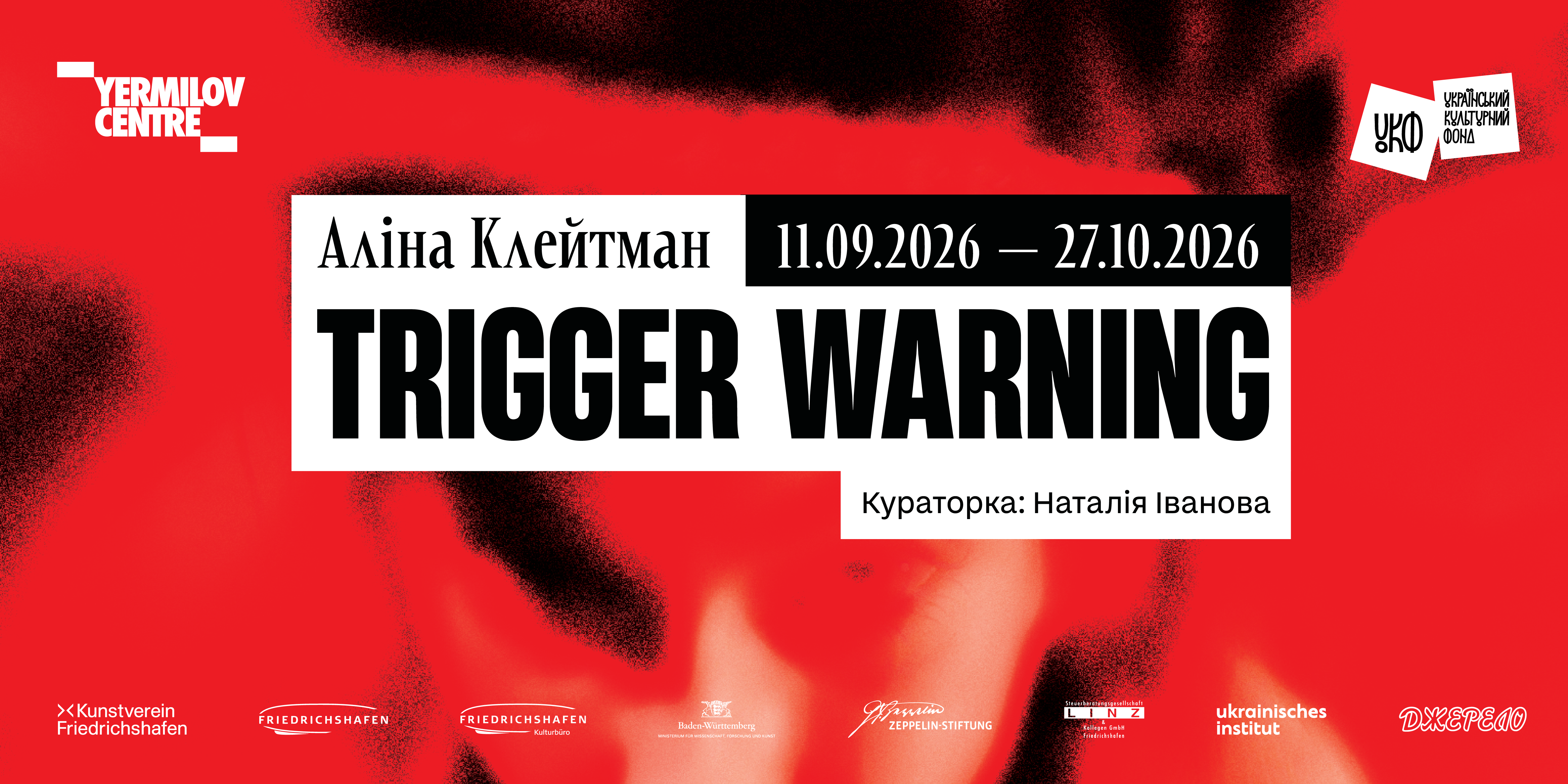
Alina Kleytman describes her own method as hysterical realism—a way of speaking about a reality that can no longer be viewed soberly, because it itself behaves hysterically.
In the new series Trigger Warning (Межа чутливості), the artist continues to explore the narration of the ongoing war with Russia at the level of the dialectics between the visual and the discursive that shapes the contemporary narrative. Its title refers to the contemporary censorship of images and to the illusory idea that, in today’s media space, we can choose what exactly to look at. The light-grey blur familiar to us from Instagram restrictions offers the user a choice: to open the image now and confront the pornographic and violent, or to remain only at the level of their own imagination, attempting to protect themselves from a new traumatic experience.
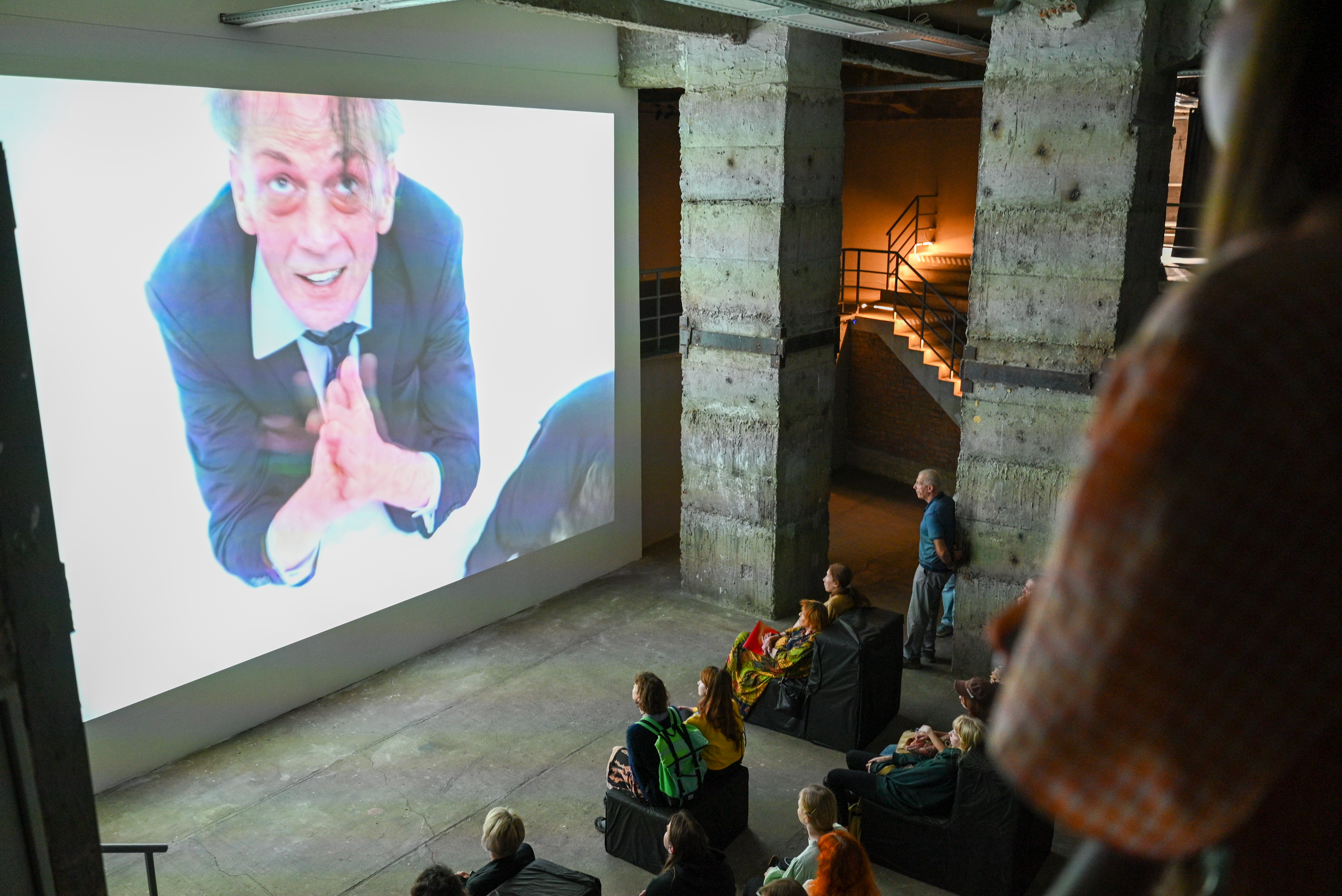
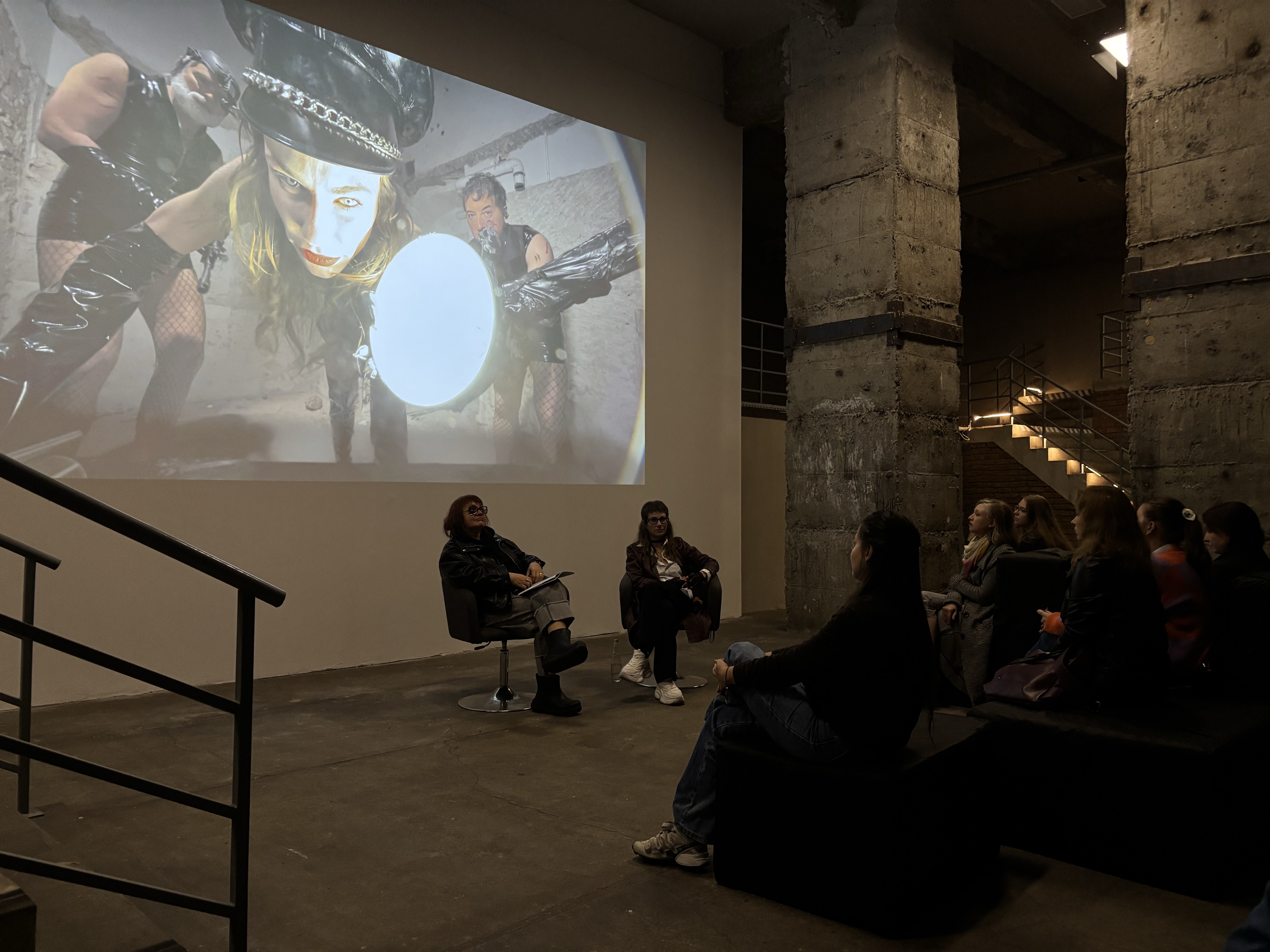
Three films created specifically for the project are presented at the YermilovCentre: Are u tired?, Thank You, Daddy, and Cradle of Democracy.
In her film Are u tired?, what initially appears to be a simple question about exhaustion turns into a relentless political and psychological interrogation. Addressing the viewer directly, Kleytman poses a series of questions about violence, loyalty, and moral responsibility. The interrogations are intercut with eroticized armed figures in fetish attire, collapsing the boundaries between military power, desire, and spectacle.
Exhaustion is human, yet in a prolonged conflict it can also become an excuse for disengagement, while others have no possibility of leaving the war. Through the visual languages of BDSM, propaganda, and bureaucratic ritual, Are u tired?implicates the viewer in the seductive mechanisms through which contemporary power demands participation.
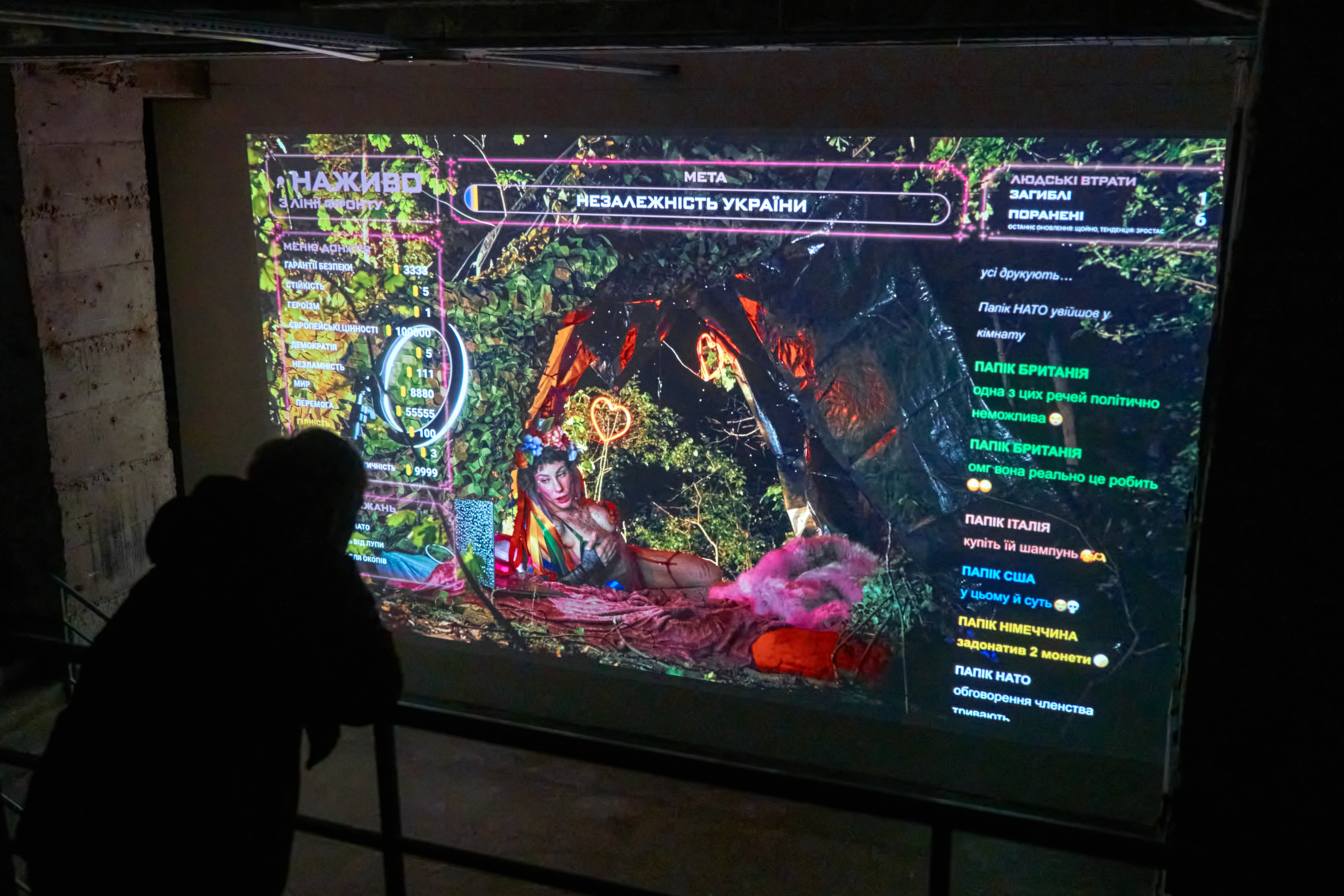
Thank You, Daddy! continues the exploration of dependency, spectacle, and exchange. Presented as a webcam livestream broadcast from a makeshift frontline tent, the work satirically reflects on the unequal dynamics of international support during wartime. Wearing lingerie and a floral crown in the colours of the Ukrainian flag, Kleytman performs for an audience of anonymous “Daddies”—Daddy Europe, Daddy NATO, Daddy USA, Daddy Germany, Daddy Poland—who reward her with tokens for abstract ideals while funding a wishlist in which anti-dandruff shampoo sits alongside Leopard 2 tanks and NATO membership.
As the “Independence of Ukraine” progress bar remains incomplete and the human cost counter continues to rise, the work reveals a world in which ethical convictions become a commodity, political solidarity becomes a branded performance, and vulnerability becomes a resource to be consumed.
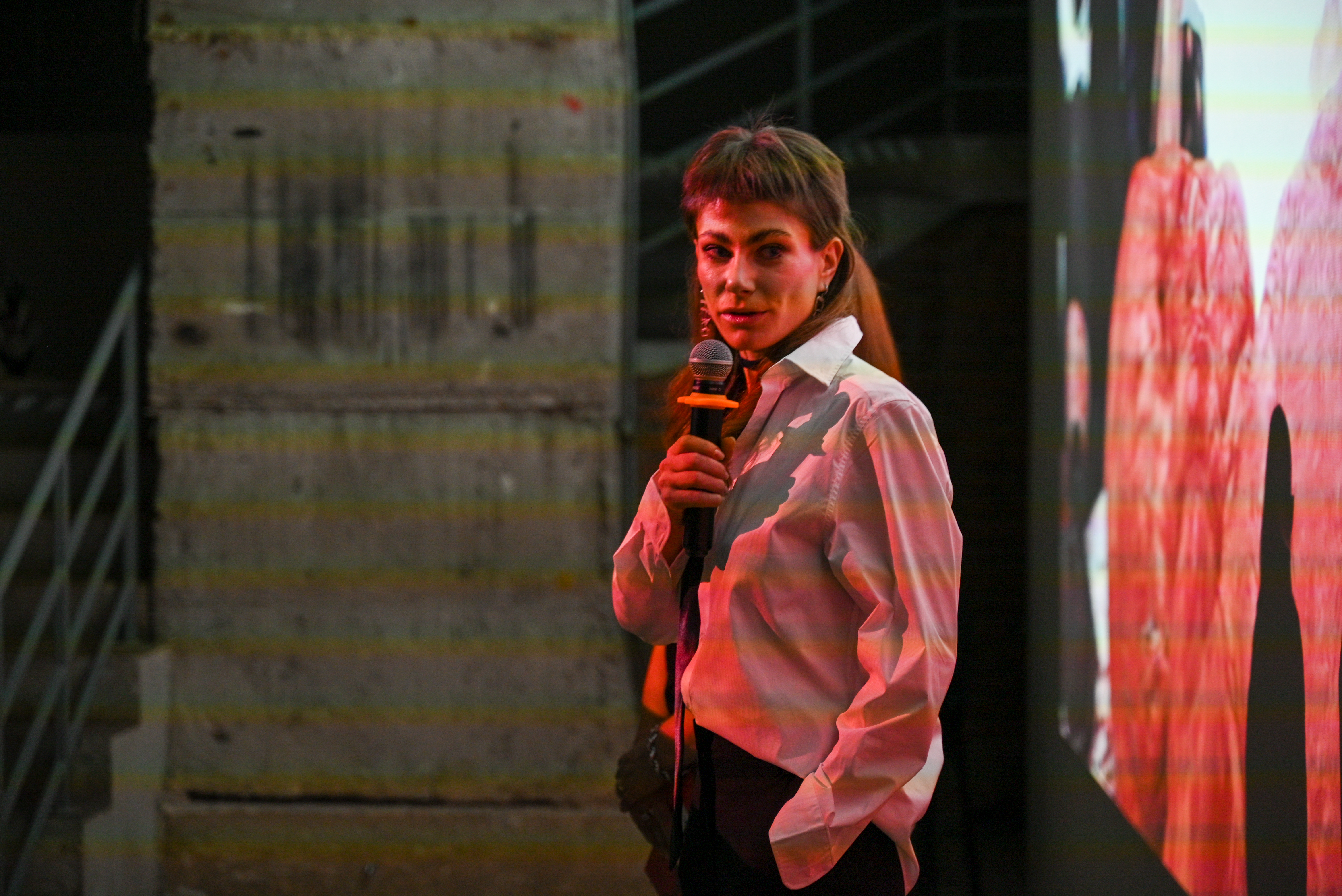
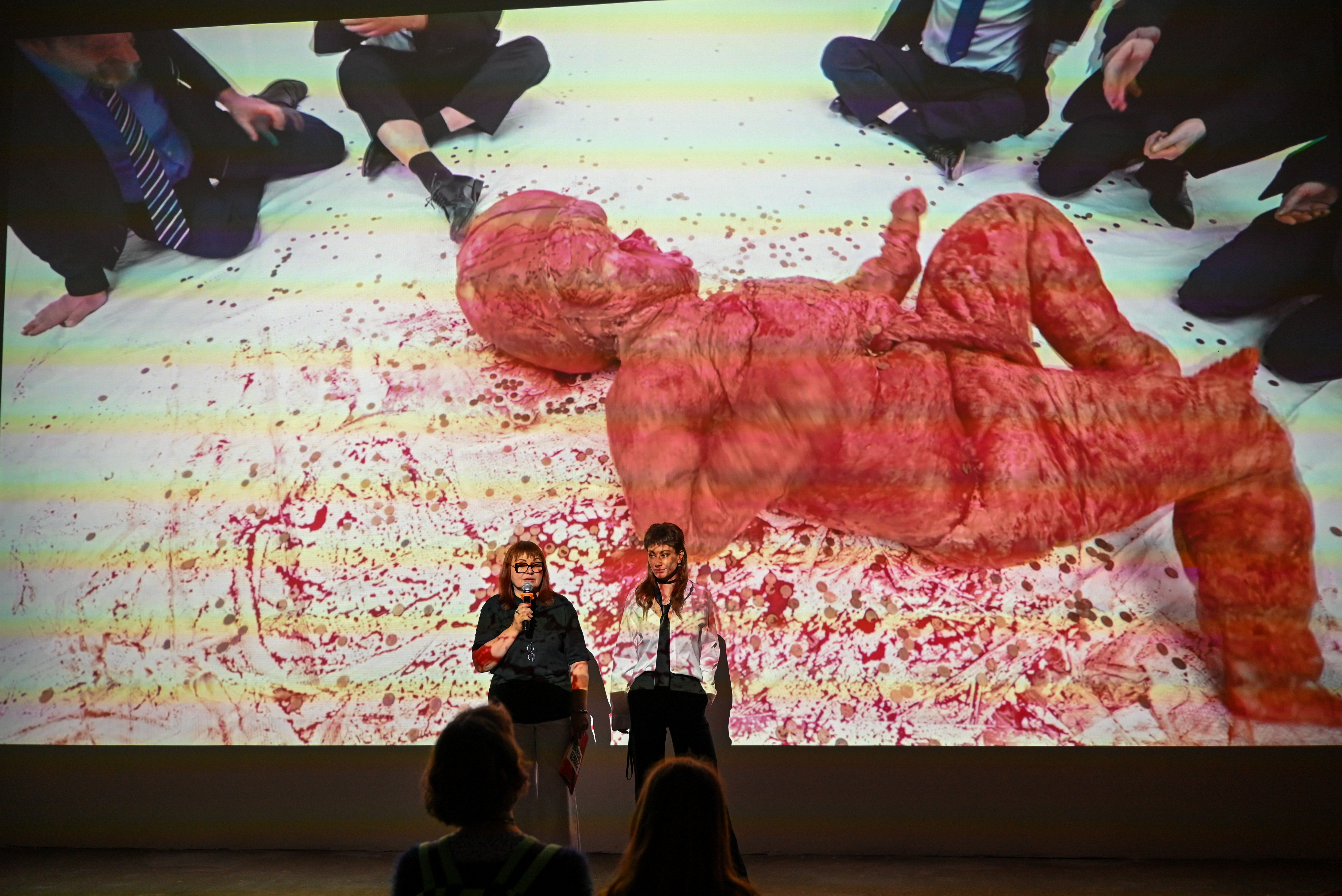
In Cradle of Democracy, Kleytman stages a grotesque allegory of political birth. Appearing as a newborn, she writhes helplessly on the floor while an audience dressed in business attire applauds and throws coins at her. Birth becomes spectacle, vulnerability becomes currency, and participation is reduced to performance.
Rather than presenting democracy as an abstract ideal, Kleytman gives it a body that performs, negotiates, desires, suffers, and remains open to the gaze of others. The work asks what remains of a political order that continues to celebrate itself while its rituals have become exhausted, transactional, aggressive, or grotesque. Kleytman lifts the veil of idealisation, revealing not a system that has simply failed, but one that continues to function and, in the very process of functioning, exposes its own contradictions. Through dark absurdism, Cradle of Democracy reveals the uneasy entanglement of public approval, capitalist spectacle, and the violence hidden within the language of democratic participation.
Thus, the exhibition Trigger Warning places its viewer in the uncomfortable position of being unable to demand justice from the visual. It forces us to feel that the image has lost its privilege of being evidence of truth and has instead become an attempt to reproduce itself within the logic of reclaiming its own visibility, with the helpless hope that, perhaps this time, reality will prevail over reproducibility and the algorithms of display.
The institutional solo exhibition Trigger Warning was previously presented at Kunstverein Friedrichshafen (Germany) in July–August 2026.
11.09 - 27.10
Alina Kleytman describes her own method as hysterical realism—a way of speaking about a reality that can no longer be viewed soberly, because it itself behaves hysterically.
In the new series Trigger Warning (Межа чутливості), the artist continues to explore the narration of the ongoing war with Russia at the level of the dialectics between the visual and the discursive that shapes the contemporary narrative. Its title refers to the contemporary censorship of images and to the illusory idea that, in today’s media space, we can choose what exactly to look at. The light-grey blur familiar to us from Instagram restrictions offers the user a choice: to open the image now and confront the pornographic and violent, or to remain only at the level of their own imagination, attempting to protect themselves from a new traumatic experience.
Three films created specifically for the project are presented at the YermilovCentre: Are u tired?, Thank You, Daddy, and Cradle of Democracy.
In her film Are u tired?, what initially appears to be a simple question about exhaustion turns into a relentless political and psychological interrogation. Addressing the viewer directly, Kleytman poses a series of questions about violence, loyalty, and moral responsibility. The interrogations are intercut with eroticized armed figures in fetish attire, collapsing the boundaries between military power, desire, and spectacle.
Exhaustion is human, yet in a prolonged conflict it can also become an excuse for disengagement, while others have no possibility of leaving the war. Through the visual languages of BDSM, propaganda, and bureaucratic ritual, Are u tired?implicates the viewer in the seductive mechanisms through which contemporary power demands participation.
Thank You, Daddy! continues the exploration of dependency, spectacle, and exchange. Presented as a webcam livestream broadcast from a makeshift frontline tent, the work satirically reflects on the unequal dynamics of international support during wartime. Wearing lingerie and a floral crown in the colours of the Ukrainian flag, Kleytman performs for an audience of anonymous “Daddies”—Daddy Europe, Daddy NATO, Daddy USA, Daddy Germany, Daddy Poland—who reward her with tokens for abstract ideals while funding a wishlist in which anti-dandruff shampoo sits alongside Leopard 2 tanks and NATO membership.
As the “Independence of Ukraine” progress bar remains incomplete and the human cost counter continues to rise, the work reveals a world in which ethical convictions become a commodity, political solidarity becomes a branded performance, and vulnerability becomes a resource to be consumed.
In Cradle of Democracy, Kleytman stages a grotesque allegory of political birth. Appearing as a newborn, she writhes helplessly on the floor while an audience dressed in business attire applauds and throws coins at her. Birth becomes spectacle, vulnerability becomes currency, and participation is reduced to performance.
Rather than presenting democracy as an abstract ideal, Kleytman gives it a body that performs, negotiates, desires, suffers, and remains open to the gaze of others. The work asks what remains of a political order that continues to celebrate itself while its rituals have become exhausted, transactional, aggressive, or grotesque. Kleytman lifts the veil of idealisation, revealing not a system that has simply failed, but one that continues to function and, in the very process of functioning, exposes its own contradictions. Through dark absurdism, Cradle of Democracy reveals the uneasy entanglement of public approval, capitalist spectacle, and the violence hidden within the language of democratic participation.
Thus, the exhibition Trigger Warning places its viewer in the uncomfortable position of being unable to demand justice from the visual. It forces us to feel that the image has lost its privilege of being evidence of truth and has instead become an attempt to reproduce itself within the logic of reclaiming its own visibility, with the helpless hope that, perhaps this time, reality will prevail over reproducibility and the algorithms of display.
The institutional solo exhibition Trigger Warning was previously presented at Kunstverein Friedrichshafen (Germany) in July–August 2026.
Current events
04.07.25 –
Presentation
News
16.07.26 – 16.08.26
Exhibition
06.05.26 – 31.05.26
Exhibition
Current events

Current events


04.07.25 -
Presentation

News

16.07.26 - 16.08.26
Exhibition

06.05.26 - 31.05.26
Exhibition